

About this guideline
This guideline explains how food businesses can determine the shelf life of products and meet labelling requirements. It does not cover seafood products.
This guideline does not replace the need to understand and comply with the Standards referred to throughout.
In Australia, businesses process, package and label meat and meat products to ensure food is safe and suitable for consumers.
Businesses may sell:
- raw meat, chilled or frozen
- processed meat products, including products that have been heated, cured, dried, fermented or canned
Depending on the processing method and product composition, businesses may sell meat products at ambient, chilled or frozen temperatures.
Shelf life
Shelf life is the period during which a product remains safe and suitable for human consumption under its intended storage conditions.
Processing conditions, product composition and temperatures throughout the supply chain all affect shelf life.
How shelf life ends
Shelf life may end in different ways.
Pathogen growth
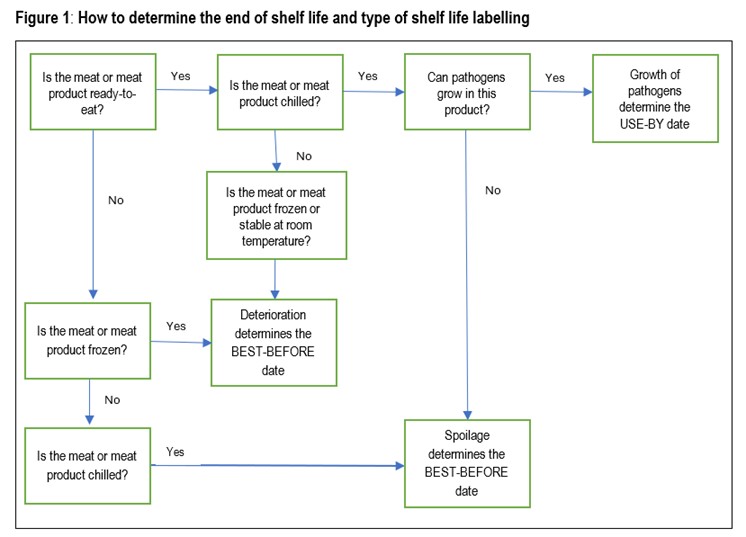
Products may become unsafe when pathogenic bacteria grow. For example, Listeria monocytogenes can grow in some ready‑to‑eat, refrigerated processed meats. In these cases, shelf life is set to the number of days of refrigerated storage before significant bacterial growth occurs.
Spoilage
Products may become unsuitable for consumption when bacteria, yeasts or moulds cause changes to colour, odour or texture. Raw meat intended to be cooked usually reaches the end of shelf life through spoilage.
Deterioration
Even when bacteria or moulds cannot grow, products may deteriorate over time. Changes in colour, odour, flavour or texture may make the product unsuitable for sale. For example, beef jerky may change colour, or frozen meat may change texture during storage.
How shelf life ends determines how businesses test shelf life and how they label products (Figure 1).
Determining shelf life
Businesses can determine shelf life in several ways.
Pathogen growth
If shelf life may end because of pathogenic bacteria growth (for example, Listeria monocytogenes), regulations in the Food Standards Code or relevant guidelines set shelf life requirements.
The Australian Meat Industry Council’s Guidelines for the Safe Manufacture of Smallgoods (3rd edition) provide useful guidance for these products.
Spoilage or deterioration
For common products, businesses may rely on an accepted or “consensus” shelf life from authoritative sources.
For example, Meat & Livestock Australia provides a shelf life calculator for beef and lamb products under defined conditions.
When using a consensus shelf life, businesses must ensure:
- the shelf life is determined at 5°C, unless another temperature is assured
- the hygienic quality of the product at the start of shelf life is comparable
- the packaging system is the same
Businesses should still verify shelf life to confirm it meets expectations.
Shelf life trials
If no consensus shelf life exists, businesses may estimate shelf life based on experience or conduct a shelf life trial.
Trials must:
- use the same product and packaging system intended for sale
- reflect realistic supply‑chain temperatures
- measure the factor that ends shelf life (for example, pathogen growth, odour, colour or appearance)
Unless evidence supports another temperature, businesses should conduct trials at 5°C.
Customers may specify shelf life testing requirements, which businesses must follow.
Labelling
The Australia New Zealand Food Standards Code (the Code) requires food businesses to provide information so consumers can make informed choices.
Part 1.2 of the Code sets out labelling and information requirements, including specific rules for meat products (Standard 2.2.1).
Each food safety program must include procedures for collecting data to validate and verify label claims.
Information required on labels
Labels must include the following information, where applicable:
- Name of the food (some names are mandatory for meat products)
- Name and address of the supplier in Australia
- Lot identification
- Allergen declarations and advisory statements, including sulphites, wheat, nuts and soy
- Storage and use directions
- Date marking, including date of packaging and best‑before or use‑by dates
- Ingredient list and percentage declarations
- Nutrition information, including energy and nutrient content
Incorrect allergen labelling is a common cause of product recalls.
Date marking
All packaged meat products must show the date of packaging. Products with a shelf life of two years or less must also display a best‑before or use‑by date.
The meat processor, packer or retailer determines shelf life.
In some cases, businesses may choose to use a use‑by date instead of a best‑before date to prevent sale after that date.
Date marking definitions
Use‑by date
The date before which consumers must eat the food for health or safety reasons. Businesses must not sell or allow consumption after this date.
Best‑before date
The date until which the product retains its quality when stored as directed. Food may still be safe after this date but may have lost quality.
Packed on date
The date the product was packed. Businesses must not use this date for retail sale.
Further information
- CSIRO (2021), Refrigerated storage of perishable foods – CSIRO(opens in a new window)
- CSIRO (2002), Storage life of meat
- CSIRO (2006), Shelf‑life testing: methods for determining the claimable life of meat products
- US Food and Drug Administration (2018), Refrigerator & freezer storage chart
Disclaimer
This information provides general guidance only. Businesses must rely on the current Standards to meet legal requirements. The regulator does not guarantee the accuracy, reliability, currency or completeness of this information and accepts no legal liability arising from its use.
Updated