

This guideline helps you understand how to manage Listeria and what to include in your Listeria management plan.
You must understand and comply with the standards referenced in this guidance.
Key requirements
You must:
- hold a Safe Food Victoria licence
- have a documented Listeria management plan
- separate raw and ready‑to‑eat products
- cook and cool products using validated processes
- record all processing data
- implement environmental and product testing
- respond immediately to positive Listeria results
Listeria risks and how it spreads
Listeria is a foodborne pathogen commonly found in raw foods. It spreads to processed foods through:
- cross‑contamination
- poor hygiene
- inadequate processing
Foods associated with Listeria include dairy, meat, seafood, fruits and vegetables.
Ready‑to‑eat foods are at higher risk because they may not be cooked or reheated before consumption, and may be contaminated before packaging.
Listeria monocytogenes is the most common type associated with foodborne illness. It can cause serious illness or death, particularly in vulnerable people.
Listeria survival and growth
Listeria can survive and grow under a wide range of conditions:
- grows at temperatures as low as 1 °C
- survives freezing and thawing
- grows best at pH 5.0 to 9.0
- can persist at low water activity (≥0.90)
- tolerates salt levels up to 10%
- survives without oxygen (including vacuum and modified atmosphere packaging)
Cooking to 65 °C for 10 minutes (or equivalent) destroys Listeria.
Your Listeria management plan
You must include a Listeria management plan in your food safety program.
The plan must apply to all ready‑to‑eat meat processing and packaging activities.
Your plan must include:
- nominated trained personnel responsible for the plan
- training schedules and records for staff
- a sampling plan showing all sampling locations
- procedures for environmental and product sampling
- testing arrangements (external or in‑house)
- systems to record and review results
- actions to take if Listeria is found
- regular review of the plan (at least annually or when processes change)
Two key indicators form the basis of your plan:
- environmental monitoring
- product testing
Control Listeria during processing
You must control contamination throughout processing and handling.
Separation and hygiene
You must:
- keep raw products separate from ready‑to‑eat products at all times
- maintain strict hygiene in processing and packaging areas
- prevent contamination from equipment, surfaces and staff
Cooking requirements
If you cook ready‑to‑eat products, you must:
- achieve a core temperature of at least 65 °C for 10 minutes, or an approved equivalent
- record all processing data
- validate and obtain approval for alternative heating processes
Cooling requirements
You must:
- cool products in line with AS 4696
- minimise contamination during cooling
- validate and obtain approval for alternative cooling processes
Post‑processing risk
The highest risk of contamination occurs after cooking.
You must ensure:
- hygienic handling
- clean equipment and surfaces
- controlled packaging processes
Testing and monitoring requirements
You must verify your controls through environmental and product testing.
Environmental monitoring
Select sampling sites across your processing environment based on risk. Include all potential contamination sites relevant to your operations.
For areas where ready‑to‑eat (RTE) products are manufactured, you must:
- conduct swabbing at least 5 times each month
- carry out swabbing before and during processing operations
Sampling zones
Sampling sites should be divided into two zones:
Zone | Description | Examples |
|---|---|---|
| Zone 1 | Food contact surfaces | Slicers, dicers, hoppers, conveyors, spiral freezers in direct contact with cooked product, tables, benches, utensils, open bearings on machines, brine tanks. |
| Zone 2 | Non‑food contact surfaces | Floors, walls, ceiling, drain outlets, condensate in chillers and freezers, conveyors, air vents, chiller doors, switches, floor joints and crevices, pooling water. |
Swabbing technique
You must use sterile swabbing equipment (for example cotton buds, sponges or gauzes).
- Use a dry swab on moist surfaces
- Use a moistened swab (with sterile peptone water) on dry surfaces
When taking a sample:
- swab at least 50 cm²
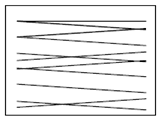
- follow a close zig‑zag pattern to cover the entire surface
- rotate the swab (if using a cotton bud) to ensure full contact
After sampling:
- store samples below 5 °C
- test samples within 24 hours

Product testing
You must:
- test RTE products at least quarterly
- test a minimum of one 25 g sample per product type
- ensure testing reflects normal production
📷 Insert figure: Product sampling example
Laboratory requirements
Test samples using approved methodology and a NATA‑registered laboratory.
If you carry out in‑house testing, you must:
- use methods approved by recognised bodies (for example AOAC)
- verify test kit methods annually (proficiency testing) against laboratory‑based methods
Starting or changing production
When starting or introducing new products, you must:
- test for Listeria monocytogenes fortnightly for 3 months
- validate all new products
If no positive results occur, you may move to quarterly testing.
a { text-decoration: none; color: #464feb; } tr th, tr td { border: 1px solid #e6e6e6; } tr th { background-color: #f5f5f5; }
Listeria testing requirements for ready‑to‑eat meat products
Microbiological limits
The Food Standards Code (Standard 1.6.1) sets limits for Listeria monocytogenes in ready‑to‑eat (RTE) foods:
| Food category | Limit |
|---|---|
| Food that supports growth of L. monocytogenes | Not detected in 25 g |
| Food that does not support growth of L. monocytogenes | ≤ 100 cfu/g |
Foods that do not support growth
An RTE food is considered not to support the growth of Listeria monocytogenes if it meets at least one of the following criteria:
- refrigerated shelf life is 5 days or less
- pH is less than 4.4
- water activity is less than 0.92
- pH is less than 5.0 and water activity is less than 0.94
- the product is frozen (consumed frozen or thawed immediately before use)
- validated data shows L. monocytogenes will not increase by more than 0.5 log cfu/g over the stated shelf life
Sampling size and frequency
You must sample all product types produced at your facility, including:
- whole products
- portioned products
- sliced products
- cooked sausages and similar products
You must:
- take one representative 25 g sample per product type
- sample in line with the AMRG Guidelines for the Management of Listeria (Standard 4.2.3)
- ensure sampling reflects normal production conditions
- include all processing categories produced onsite
Representative sampling
You may take a representative sample instead of sending a whole unopened unit to the laboratory.
If you do this, you must:
- use strict aseptic techniques during sampling and handling
- prevent cross‑contamination
A positive result from a representative sample is treated the same as a positive result from an unopened packaged product. It will trigger investigation, corrective action and verification requirements under the AMRG standard.
Exemption
Unpackaged smallgoods with a shelf life of less than 5 days are not required to comply with AMRG Standard 4.2.3.
Product sampling example
📷 Insert figure: Product sampling example
Figure 1: Take one 25 g sample from each product type (for example, whole, portioned or sliced products).
Seasonal Listeria testing
Facilities that produce packaged RTE products infrequently may use a seasonal testing approach.
These facilities must still manage risk. Year‑round testing requirements under the AMRG standard aim to identify contamination early rather than during peak production periods.
Seasonal production requirements
To apply seasonal testing, your food safety program must identify your business as a seasonal RTE producer.
You must:
- conduct environmental swabbing for at least 2 weeks before production starts, covering all RTE areas
- demonstrate these areas are free of L. monocytogenes
- produce RTE products under test‑and‑hold conditions during the production period
Your procedures must be approved by your auditor.
If you do not have approved seasonal procedures, you must:
- carry out quarterly product testing, and
- conduct monthly environmental swabbing
Evidence to support applications
Safe Food Victoria may approve alternative approaches where you demonstrate compliance with relevant standards.
You can support an application by:
- using the FSANZ guidance on microbiological criteria for Listeria monocytogenes
- providing predictive modelling data
- conducting challenge studies (optional)
Actions if Listeria is detected
If Listeria monocytogenes is detected, you must:
- notify Safe Food Victoria within 24 hours
- isolate and hold affected product
- recall product already distributed
- investigate the source of contamination
Clearance and restart
You must:
- implement a test‑and‑hold program
- achieve acceptable results for 3 consecutive batches before resuming production
A batch is:
- up to 24 hours of production, or
- the period between cleaning and sanitation
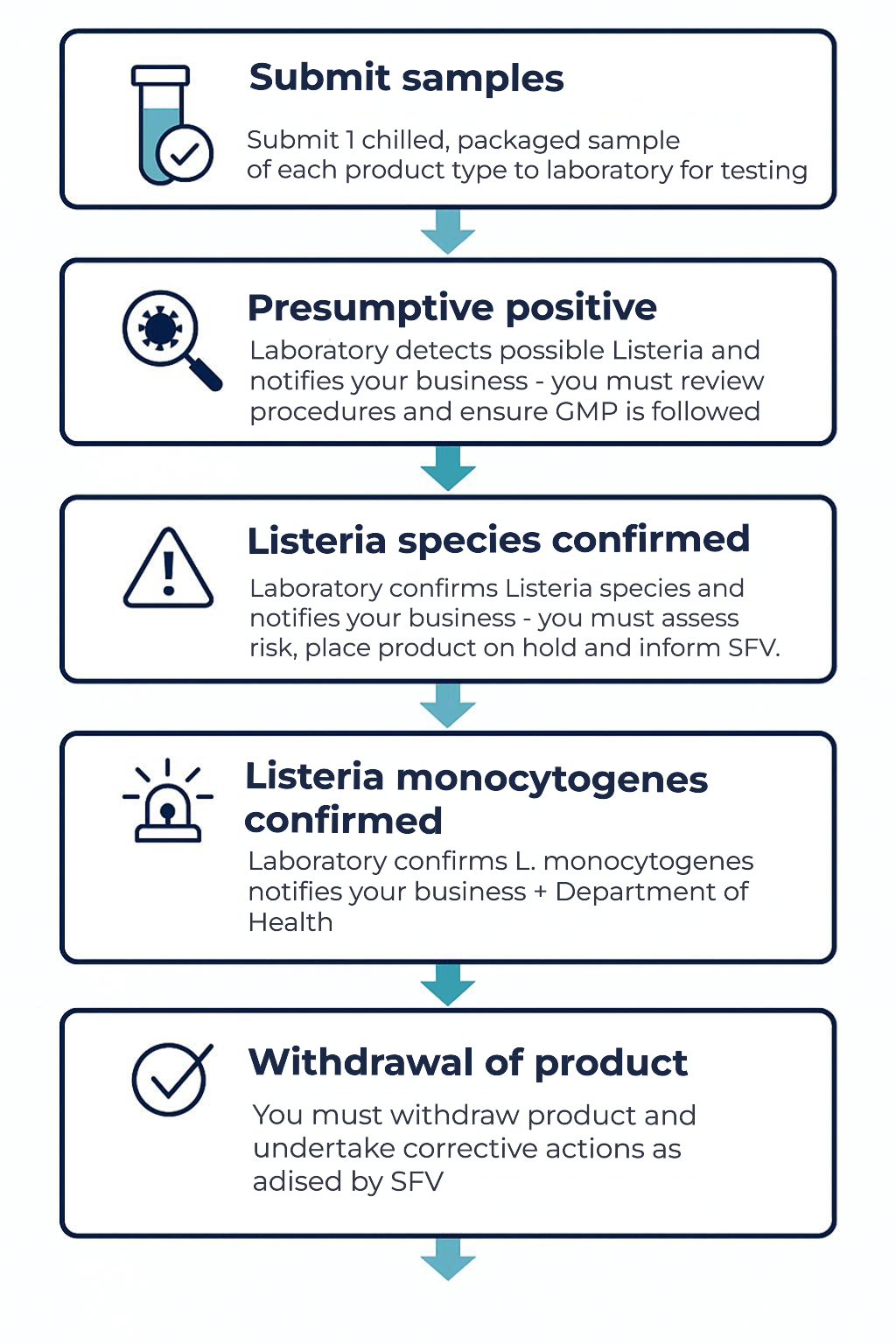
What happens when Listeria is detected
This is how the process works from sampling through to confirmed Listeria monocytogenes detection and response.
Record keeping
You must keep records to demonstrate compliance.
You must keep records for:
- processing (cooking and cooling)
- environmental monitoring
- product testing
- validation and verification
- corrective actions
Records must:
- demonstrate control of Listeria risks
- be available for audit
Further information
- Food Standards Code – Food Standards Australia New Zealand
- AMRG Guidelines for the Management of Listeria
- Cook Chill for Foodservice and Manufacturing (AIFST)
Updated