

Standards and guidelines you must follow
A well-designed and constructed facility controls food safety risks like cross-contamination.
There are construction and design requirements for food facilities in the:
- Australia New Zealand Food Standards Code(opens in a new window)
- Australian Standard AS 4696 – Hygienic Production and Transportation of Meat and Meat Products for Human Consumption
Construction and design requirements are also set out in the Victorian Standard for the Hygienic Production of Meat at Retail Premises.
You need to understand these requirements. The information on this page is a guide only.
Facility requirements
Facility requirements set out in the standards include:
- Food businesses must have a clean and hygienic environment.
- Adequate space is required for food processing and storage.
- Floors, walls and ceilings must be easy to clean and maintain.
- Ventilation systems must be adequate to prevent contamination.
- Handwashing facilities must be available for staff.
Equipment requirements
Equipment requirements set out in the standards include:
- Food businesses must have appropriate equipment for processing, storing and packing food.
- Equipment must be made of materials that are safe for food contact.
- Regular maintenance and cleaning of equipment is essential.
- Temperature control equipment is required to ensure food safety.
Construction requirements
Construction requirements set out in the standards include:
- Food premises must be constructed to prevent pests and contamination.
- Surfaces must be smooth and free from cracks to allow effective cleaning.
- Adequate lighting is required in food processing areas.
- Plumbing and drainage systems must be designed to prevent cross‑contamination.
Construction and design considerations
Floor plan design
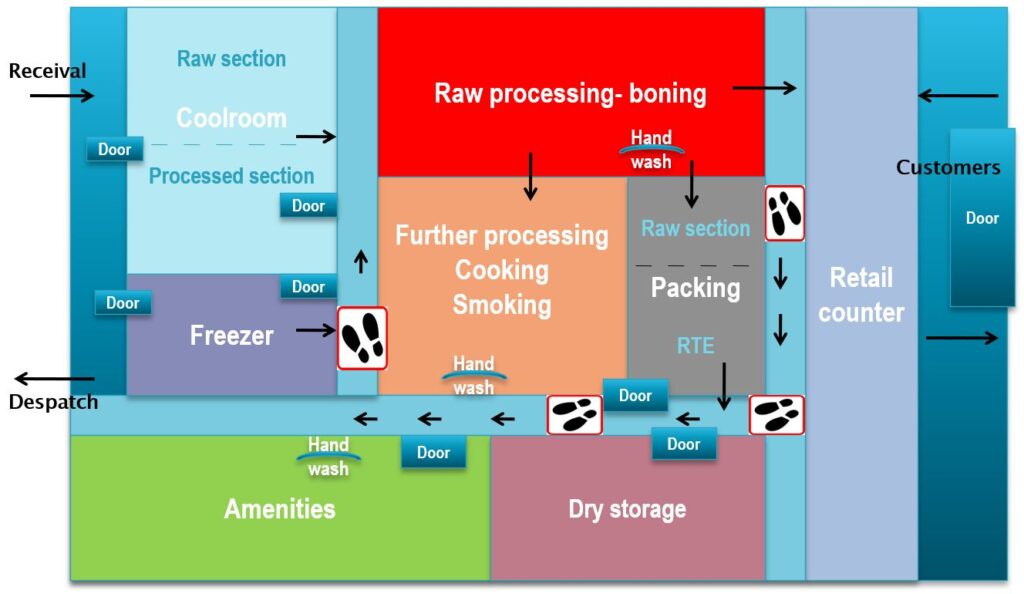
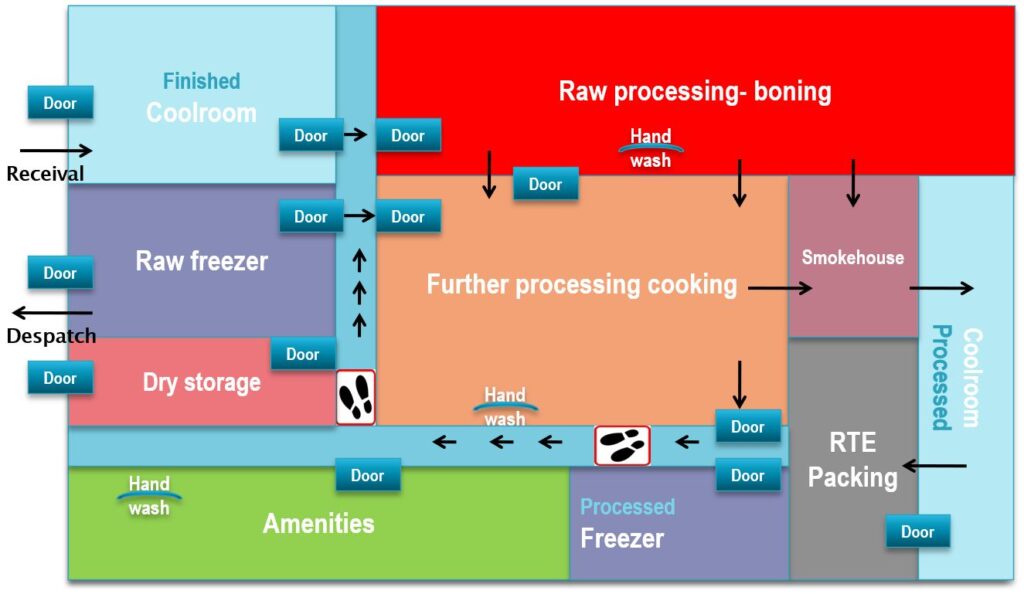
The layout of your facility has to keep raw meat separate from ready-to-eat food to avoid contamination.
See the two floor plan examples that show this separation.
Retail butcher shop facility
Further meat processing facility
Surfaces
The materials used for surfaces (walls, floors and benches) in your facility have to be suitable. Surfaces cannot react with the food or cleaning chemicals.
Surfaces have to be smooth, waterproof and resistant to rust. Don’t use materials that can trap harmful bacteria and odours and are hard to clean such as wood.
Choose light-coloured surfaces that are easy to inspect, instead of dark ones.
Surface materials for the facility need to be strong so they won’t be damaged with regular use.
Floor drainage
Keep the floor flat so water doesn’t collect in puddles.
Install drains in strategic places to get rid of water effectively.
Make sure the size of grease traps reflects the amount of product the facility processes.
Updated